At the intersection of personal biography and the collective memory of her Mediterranean heritage, Felekşan Onar discovered in glass a timeless vocabulary — a primary language through which to articulate ideas around unfinished identities, narratives constructed across long spans of time, complex historical connections, and the relationship between politics and society in the contemporary world. From her Aegean hometown of Söke to the ancient and modern city of Istanbul, situated between the Bosphorus, the Sea of Marmara and the Black Sea, Onar's life has been shaped by geographies of exchange, migration and cultural encounter. Glass has become more than a material in her practice; it is a living history, carrying cultural and social references through its simultaneous transparency and opacity, fragility and permanence.
One of Onar's best-known bodies of work, Perched (2017), uses the metaphor of birds to reflect on displacement, migration and the search for belonging. Presented in major international museums and the subject of a monograph, the series established an enduring visual language that continues to evolve in her practice. In After Utopia: The Birds (2023), presented at the Sadberk Hanım Museum in Istanbul, Onar expanded this narrative through sculpture and stop-motion film, exploring the fragile relationship between individual lives and collective histories. Shattered (2024), conceived in response to the devastating earthquakes in Turkey, further developed her exploration of vulnerability, loss and resilience, with works subsequently presented at the Museum of Islamic Art in Doha and Harvard Art Museums.
Alongside these explorations, Onar's practice engages with the historical and cultural connections between geographies. Her installation 41X (2018), presented in Venice during the 16th International Architecture Exhibition, drew upon the bridges of Venice to examine centuries of exchange between the Ottoman Empire and the Venetian Republic. This investigation found a new expression in Passaggi (2026), a monumental suspended glass installation commissioned for Murano Illumina il Mondo in Piazza San Marco, Venice. Through the transformation of architectural forms into luminous glass elements, Onar continues to explore the bridge as both a physical structure and a metaphor for connection, passage and cultural memory.
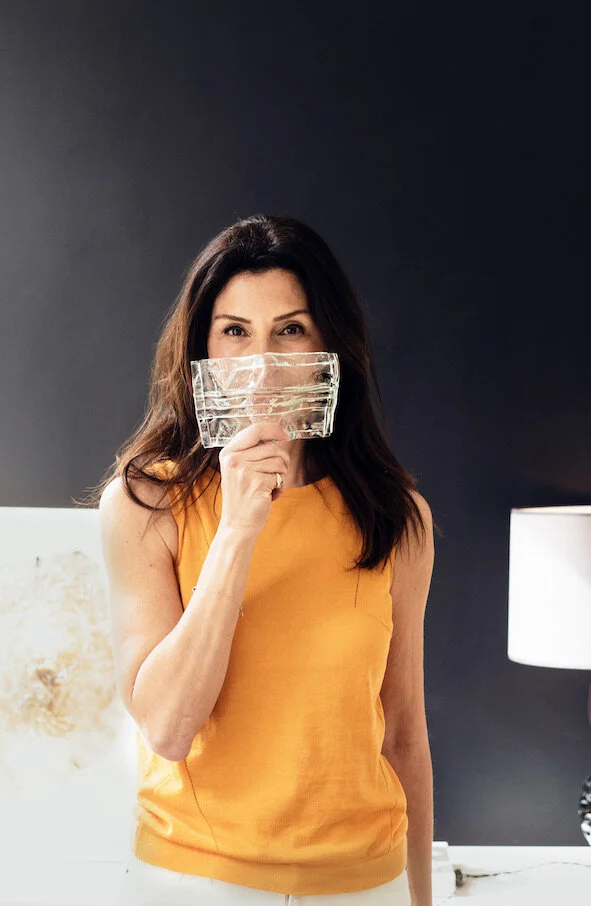
Onar began her journey into glass in a private atelier and subsequently received formal training in traditional glassmaking at Glass Furnace in Istanbul. In 2009, she officially established Fy-shan Glass Studio, developing a practice that moves between historical craftsmanship, contemporary art and design. Working across techniques including kiln casting, glassblowing, hot-forming, fusing, flameworking and cold working, she approaches glass as a medium of both technical experimentation and conceptual expression.
Born and raised in Turkey, Felekşan Onar studied economics and music history at Cornell University and completed executive education at Harvard Business School. Based in her atelier in Istanbul's historic Pera district, she also works internationally, particularly in Murano and New York. Her works have been presented at institutions including the Victoria and Albert Museum, London; the Museum für Islamische Kunst, Berlin; the Staatliche Kunstsammlungen Dresden; the Sadberk Hanım Museum, Istanbul; the Museum of Islamic Art, Doha; and Harvard Art Museums, Cambridge. Her work is represented in public collections including the Victoria and Albert Museum, the Museum für Islamische Kunst, Berlin; the Finnish Glass Museum in Riihimäki; the Contemporary Glass Art Museum in Eskişehir; and the Staatliche Kunstsammlungen Dresden, among others.
Quisque iaculis facilisis lacinia. Mauris euismod pellentesque tellus sit amet mollis.